 |
| https://upload.wikimedia.org/wikipedia/commons/thumb/ 6/69/Human_evolution.svg/800px-Human_evolution.svg.png |
We did two labs in this unit, the Bird Beak Lab and the Hunger Games Lab. In the bird beak lab, we observed different traits of bird beaks and we saw which phenotype did the best at collecting food. The birds with the better beak for collecting food survived and produced more offspring than the birds that didn't have a good beak to collect food. Eventually, the population of the birds became more and more like the birds with the better beak. The allele frequency of that beak phenotype increased in the population, while the others decreased, so the bird population evolved to have the better beak phenotype. In the Hunger Games Lab, we also observed different bird beaks and their abilities to collect food. Those whose beak allowed to get more food produced more offspring and survived, and those who didn't died off. From that data, we could see that the allele frequency shifted to a higher percentage of the better beak to collect food, which means that the population evolved that trait.
 |
| https://upload.wikimedia.org/wikipedia/commons/thumb/e/eb /Timeline_evolution_of_life.svg/1280px-Timeline_evolution_of_life.svg.png |
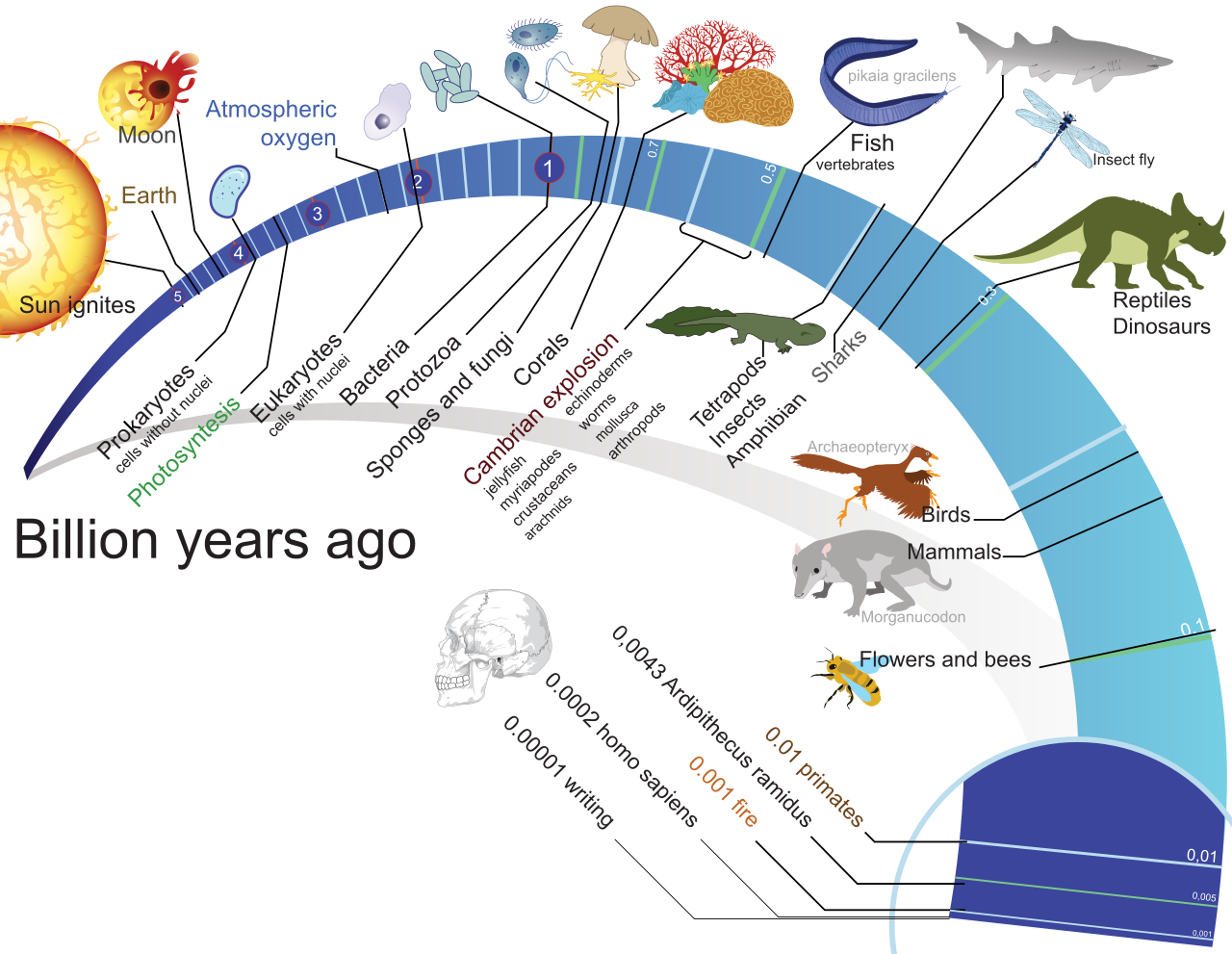
What I want to learn more about is how the traits that die off evolved in the first place, and what traits ended up surviving through natural selection all these years to make the present organisms and traits we see today. Also, I wonder about what traits and species died off over Earth's history and what caused those species and traits to die off. In the Unit 7 Reflection, I talked about my assertiveness and how I can improve and make it better. So far I feel I am assertive enough to tackle the jobs at hand. What I am doing well is that I am being assertive in the first place. What I need to do better is to be even more assertive, because I feel that I am being assertive in a passive way.

No comments:
Post a Comment