In this unit we learned about the study and organization of organisms called taxonomy. The themes and essential understandings were the defining characteristics of the different taxonomic groups. The different taxonomic groups starting from largest to smallest are domain, kingdom, phylum, class, order, family, genus, and species. The three domains are Bacteria, Archaea, and Eukarya. In bacteria, there are gram-positive (thick cell wall) and gram-negative bacteria (not thick cell wall). Archaea was discovered in the 1970's in extreme environments and are called extremophiles. Eukarya has many kingdoms: Protista, Fungi, Plantae, and Animalia. Fungi are organisms that reproduce using spores, have a fruiting body with hyphae and mycellium, and consume decayed, organic material. The different types of fungi are club fungi, sac fungi, and bread molds. Plantae are organisms that use photosynthesis or chemosynthesis to produce their own food, and they are called autotrophs. The different phyla of plants are mosses, ferns, gymnosperms (cone bearing plants), and angiosperms (flower bearing plants). Animalia are organisms that are heterotrophic and are animals. The different phyla of animals are Porifera (sponges), Cnidaria (jellyfish and coral), Platyhelminthes (flatworms), Molluska (oysters, clams, etc.), Annelida (segmented worms), Echinodermata (sea stars), Arthropoda (insects and crustaceans), and Chordata (vertebrates). Within the phylum Chordata, there are the classes Agnatha (jawless fish), Condricthyes (cartilaginous fish), Osteicthyes (bony fish), Amphibia (amphibians), Reptilia (reptiles), Aves (birds), and Mammalia (mammals).
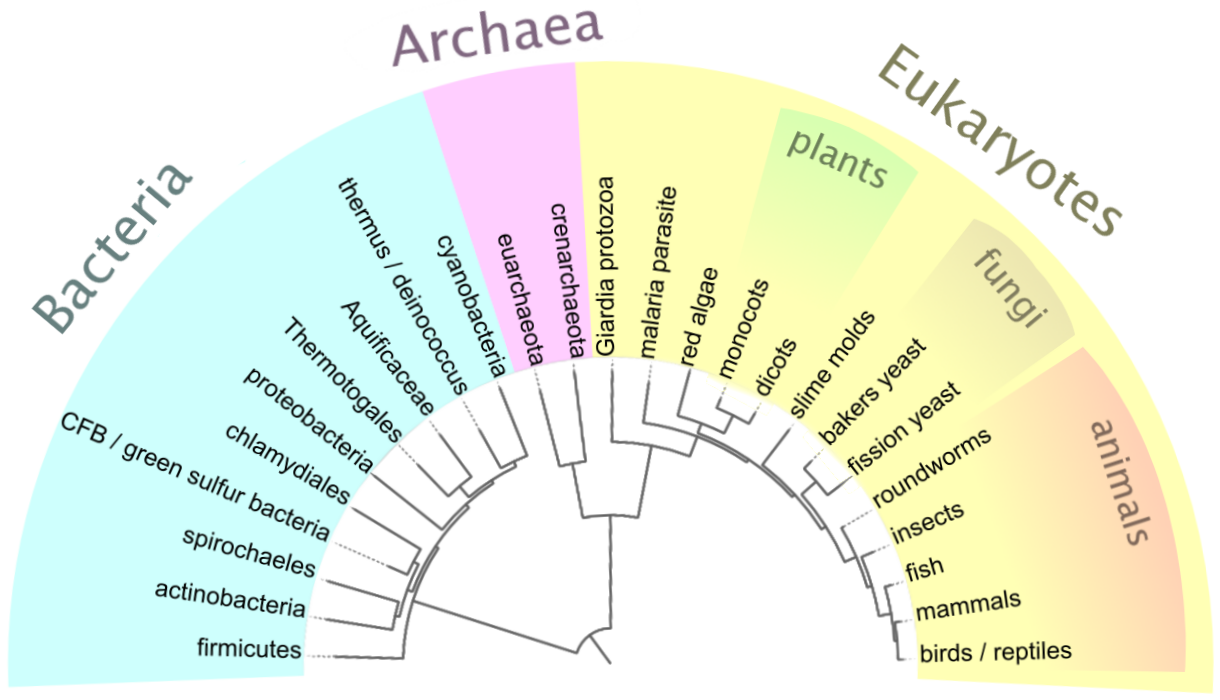 |
| https://upload.wikimedia.org/wikipedia/commons/e/e6/Simplified_tree.png |
What I want to learn more about is how did structures such as a jaw or a backbone form when there was no organism with those traits. Also I want to learn more about how life colonized land from the water. Some unanswered questions that I have are that why is the nerve cord hollow, and why do some chordates lose their notochord, hollow backbone, pharyngeal slits, and tail?
In this unit we did a project of making a scaled
Geologic Timeline. We started from the beginning of the creation of the earth to the present and we included all of the historical events, periods, eras, and biological events that occurred during earth's history. My experience was that it helped me see the expanse of earth's history, what exactly happened in the distant past, and what led to the evolution of the species we see today. It was also a good collaboration experience because I had to work in a group.
Also in this unit I made and did a presentation about an organism from the book
What on Earth Evolved: 100 Species That Changed the World by Christopher Lloyd. The organism that I chose was
Penicillium, the fungus responsible for the discovery and production of antibiotics. This organism has impacted the earth by helping humans gain strength against bacteria that would kill off humans easily. It has also impacted the world by allowing bacteria to evolve at a rapid pace, making it that we have to produce new antibiotics every year to keep up with the constant evolution of the bacteria. Below is my presentation.


No comments:
Post a Comment